
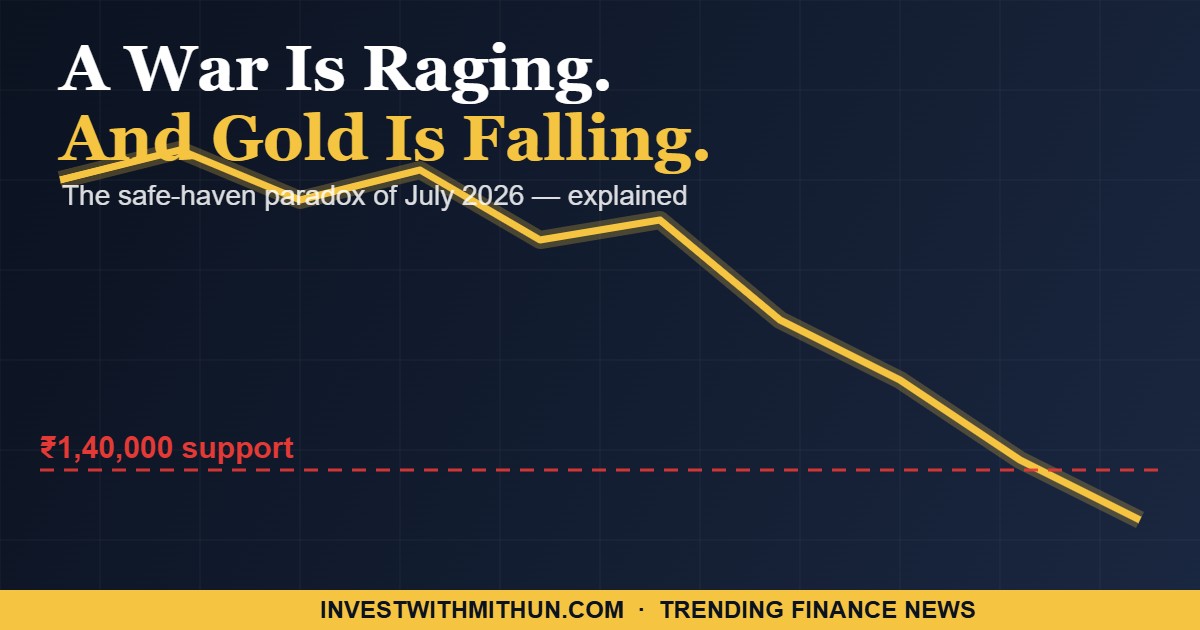
Quick Answer (Featured Snippet): Gold is falling despite the US–Iran war because the conflict pushed oil up 12–13% in a week, reviving inflation fears and bets that the US Federal Reserve may raise interest rates. Higher rates lift bond yields and the dollar, which pull money out of gold — and right now, rates are beating fear.
If you had told any Indian investor last year that there would be an active military conflict in the Middle East — American airstrikes, tankers attacked, the Strait of Hormuz disrupted — and asked them to guess what gold would do, the answer would have been instant: gold will fly.
Instead, this week, gold on MCX slipped below ₹1.40 lakh per 10 grams. Silver did something worse — it crashed to an 8-month low of around $55.58 an ounce internationally, down more than 20% in a single month.
A war is on, and the world’s most famous “safe haven” is falling.
If that makes no sense to you, this article is for you. By the end of it, you will understand exactly why this is happening, what history says about moments like this, and — most importantly — what you should actually do with your gold and silver investments right now.
Let’s start with what happened.
What Happened: The Numbers First
Here is where precious metals stood as of Friday, July 17, 2026:
| Metal | Level | Change | Context |
|---|---|---|---|
| Gold (MCX, Aug futures) | ~₹1,40,500/10g | Dipped below ₹1.40 lakh intraday | Range: ₹1,39,801–1,40,733 |
| Gold (international spot) | $3,999/oz | −0.29% on the day | Sitting exactly on the $4,000 support |
| Gold (Delhi retail, 24K) | ~₹1,43,430/10g | Off recent highs | Was ~₹1,48,460 on July 3 |
| Gold (Delhi retail, 22K) | ~₹1,31,490/10g | — | Jewellery-grade rate |
| Silver (international) | $55.58/oz | −6.9% this week | 8-month low |
| Silver (MCX, Sept futures) | ~₹2,16,328/kg | Touched ₹2,13,824 low | Retail ~₹2.30–2.35 lakh/kg |
Now hold those numbers against the backdrop. In the same week:
- The US–Iran conflict entered its sixth day of American airstrikes.
- Iranian attacks on tankers disrupted the Strait of Hormuz — the narrow sea lane that carries roughly one-fifth of the world’s oil.
- Brent crude jumped to about $85–86 a barrel, up 12–13% in five trading days.
- India’s own stock market wobbled, and the rupee slid to 96.3 against the dollar, within half a percent of its all-time low.
Fear everywhere. And yet gold fell. Silver fell harder. To understand why, you need to understand the one thing most gold buyers in India were never taught.
The One Thing Nobody Tells You About Gold
Here is the simplest way to think about it.
Gold is in a permanent tug-of-war between two forces:
Force 1: Fear. War, inflation scares, bank collapses, currency crises — anything that makes people distrust paper assets pushes money into gold. Fear pulls gold UP.
Force 2: Interest rates. Gold pays you nothing. No interest, no dividend, no rent. So every time interest rates rise, the “cost” of holding gold rises with them — because the money sitting in gold could have been earning a higher, guaranteed return in bonds or fixed deposits. Rates pull gold DOWN.
Financial professionals have a term for this: the opportunity cost of holding gold. When a US government bond pays 4.5% with zero risk, an asset that pays 0% has to work much harder to justify its place in your portfolio.
Most of the time, one force is clearly stronger, and gold moves accordingly. What makes July 2026 so unusual — and so confusing — is that the same event is feeding both forces at once.
Follow the chain:
- The US–Iran conflict disrupts oil supply through the Strait of Hormuz.
- Oil jumps 12–13% in a week to $86.
- Expensive oil means higher inflation — in transport, manufacturing, everything. You can already see it in India’s wholesale inflation, where the fuel and power index is up a scorching 27.4% year-on-year.
- Higher inflation means central banks — especially the US Federal Reserve — cannot cut interest rates. In fact, markets have started pricing in the possibility that the Fed’s next move could be a hike.
- Expectations of higher rates push up bond yields (the US 10-year is at 4.54%) and strengthen the dollar.
- Higher yields and a stronger dollar pull money OUT of gold.
So yes — the war is bullish for gold through the fear channel. But the war is also bearish for gold through the oil-inflation-rates channel. And this week, the rates channel won.
That is the safe haven paradox of 2026: the war is hurting gold because of what the war is doing to oil.
There’s one more layer. The Fed held rates at 3.50–3.75% at its June meeting, but its statement pointedly said inflation “remains elevated” — partly because of energy supply shocks. Then, on July 14, US consumer inflation actually came in cooler than expected at about 3.5%. That cooler print gave markets brief relief. But with oil up 13% in a week, traders know the July and August inflation numbers could look much uglier. The market is looking through the good news at the bad news coming. Gold is caught in the middle.
Why Silver Is Falling Twice as Hard
If gold’s fall puzzled you, silver’s crash probably alarmed you. Here are the numbers, and they are dramatic:
| Silver measure | Figure |
|---|---|
| Price (July 17) | $55.58/oz — an 8-month low |
| This week | −6.9% |
| This month | −20.6% |
| Last 12 months | +47.5% (still!) |
| Peak yearly growth | +173% year-on-year (May 14, 2026) |
Read that table twice, because it tells the whole story. Silver is down a brutal 20% in a month — and still up 47% over the year. What you are watching is not the death of silver. It is a violent correction inside an enormous bull run.
Why does silver fall harder than gold? Because silver lives a double life:
Life 1: Precious metal. Like gold, silver responds to fear and interest rates. Everything we said about gold applies to silver too.
Life 2: Industrial metal. Roughly half of silver demand comes from industry — solar panels, electric vehicles, electronics. That means silver also behaves like a stock: when investors worry about economic growth, silver gets sold the way industrial companies get sold.
Right now, both lives are being squeezed simultaneously. Rate-hike fears hit its precious-metal side. And worries that an oil shock plus higher rates will slow the global economy hit its industrial side. On top of that, silver had simply run up too far, too fast — at one point this year its price had nearly tripled year-on-year. When a market that hot turns, leveraged traders rush for the exit at the same time, and the fall becomes self-feeding.
This is also why you should be deeply skeptical of the sensational forecasts still floating around — one widely-shared headline this month predicted $375 silver in 2026. Treat numbers like that as entertainment, not analysis.
The ₹ vs $ Cushion: Why Indian Gold Falls Less Than Global Gold
Here is a detail that quietly matters enormously for Indian investors, and almost no one explains it.
International gold is priced in dollars. Indian gold is priced in rupees. So the gold price you see in India is really two prices multiplied together: the dollar price of gold × the dollar-rupee exchange rate.
This week, while dollar gold was falling, the rupee was also weakening — trading around 96.3 per dollar, close to its record low of roughly 96.96, with the RBI intervening in the market almost daily to slow the slide.
A weaker rupee makes every dollar-priced asset more expensive in rupee terms. So the falling rupee has been quietly cushioning Indian gold prices. Dollar gold is down harder than MCX gold — the rupee’s weakness absorbed part of the blow.
This cuts both ways, and you should remember the rule:
- Rupee weakens → Indian gold falls less than global gold (cushion)
- Rupee strengthens → Indian gold rises less than global gold (drag)
For an Indian investor, gold is never just a gold bet. It is a gold-plus-dollar bet. That is precisely why gold has historically been such effective insurance for Indian portfolios: the same global shocks that hurt the rupee tend to help gold, and you benefit twice.
What History Says: Wars Don’t Decide Gold. Rates Do.
It feels almost disrespectful to say that a war doesn’t drive gold. But look at what actually happens across history’s episodes, and a clear pattern emerges:
| Episode | What fear did | What rates did | What gold ultimately did |
|---|---|---|---|
| 1979–80: Iran revolution + oil shock | Panic buying; gold spiked to then-record $850 | Fed’s Paul Volcker then raised rates towards 20% | Gold crashed and stayed down for two decades |
| 1990–91: Gulf War | Gold jumped on the invasion of Kuwait | Rates were falling, but the fear faded fast | Gold gave back the entire “war premium” within months |
| 2003: Iraq War | Gold rose into the war | Rates were low and heading lower | Gold kept climbing for years — because of rates, not the war |
| 2022: Russia–Ukraine | Gold spiked to ~$2,070 in days | Fed began aggressive hiking weeks later | Gold fell ~20% over the next six months |
| 2026: US–Iran | Modest fear bid | Hike expectations rising on oil-driven inflation | Falling — so far tracking the 1980/2022 script |
The pattern is remarkably consistent: war headlines produce spikes; interest-rate cycles produce trends. The fear premium from a conflict tends to evaporate within weeks unless the conflict directly triggers a monetary consequence. When war leads to inflation which leads to rate hikes — 1980, 2022, and possibly now — gold struggles despite the fear. When conflict coincides with falling rates — 2003 — gold thrives.
If you remember one sentence from this article, make it this one: fear decides gold’s next week; interest rates decide gold’s next year.
Meanwhile, Indian Investors Are Buying the Dip
Now here is the fascinating counter-current. Even as prices corrected, Indian money has been flowing into gold at a record clip.
The latest AMFI data (for June 2026) showed gold ETFs — exchange-traded funds that let you buy gold like a share through your demat account — pulled in ₹3,443 crore in a single month, a sharp reversal from the ₹725 crore outflow the month before. For perspective, that is one of the strongest months ever recorded for Indian gold ETFs.
And it is part of a larger pattern of disciplined Indian investing: SIP inflows hit a record ₹31,781 crore in June, and domestic institutions bought roughly ₹7,600 crore of equities in just the past four sessions while foreign investors sold roughly ₹6,000 crore.
So while global traders sell gold because of American interest rates, Indian households are quietly accumulating it. Who is right? Honestly — both can be. The trader is playing the next month. The household is playing the next decade. The mistake is confusing which game you are in. Which brings us to the practical part.
Should You Buy Gold Now? The Honest Framework
Nobody — not this website, not any analyst — knows whether gold holds $4,000 next week. Anyone who claims certainty is selling something. What we can do is reason clearly about scenarios and match actions to your situation.
The key level everyone is watching: $4,000
Analysts tracking the metal describe $4,000 as the make-or-break support. The scenarios being discussed in current research:
- If $4,000 holds: a recovery towards $4,300–4,500 becomes the base case, with the near-term hurdle around $4,200.
- If $4,000 breaks decisively: a deeper correction opens up, with some houses sketching scenarios anywhere between a $4,000 retest-and-recover and a slide well below before the next leg up towards $4,900 later in the year.
In rupee terms, the ₹1.40 lakh mark on MCX is playing the same psychological role. A decisive break would likely drag MCX gold towards the mid-₹1.3 lakhs, where the rupee cushion would again soften the blow.
The three questions that actually matter
1. What is gold’s job in your portfolio? If gold is your insurance — 5–15% of the portfolio held against exactly the kind of chaos we’re seeing — then price dips are irrelevant to the thesis, and mildly helpful to the buying. Insurance is bought regularly, not timed. If gold is your trade — bought because it was going up — then understand you are trading against the Fed, and the Fed’s next moves depend on oil, which depends on a war. That is a coin-flip you cannot model.
2. Are you under-allocated or over-allocated? After gold’s massive run to $4,000 (and ₹1.48 lakh retail earlier this month), many Indian portfolios are overweight gold without having bought a gram — the price did it for them. If gold has grown beyond ~15% of your portfolio, this correction is a rebalancing signal, not a buying signal. If you hold little or no gold, staggered buying into weakness is the textbook approach.
3. Can you stagger? The single best answer to “is this the bottom?” is to make the question irrelevant. Split your intended purchase into 4–6 monthly tranches (or a gold-ETF SIP). If gold falls further, your later tranches buy cheaper. If it recovers, your early tranches caught the low. You give up the fantasy of the perfect entry in exchange for never being catastrophically wrong.
The action table
| Investor type | Situation | Sensible action now |
|---|---|---|
| Long-term allocator | Gold < 10% of portfolio | Start/continue staggered buying (ETF or SGB-style routes); the dip is your friend |
| Long-term allocator | Gold > 15% of portfolio | Do nothing or trim to target; the rally did your buying for you |
| Festive/wedding buyer | Needs physical gold in 3–6 months | Buy in 2–3 instalments starting now; waiting for a bottom before a wedding is speculation with family money |
| Silver investor | Sitting on big gains | Volatility is the price of silver’s returns; if the 20% monthly swing disturbed your sleep, your position is too large |
| New silver buyer | Tempted by the “discount” | Only with money you won’t need for 3+ years, only staggered, and only after accepting another 10–15% drawdown is possible |
| Trader | Playing the bounce | Your levels: $4,000 support, $4,200 then $4,300–4,500 resistance; keep stops honest — this is a headline-driven market |
What could change the picture fast
Watch these four triggers:
- A ceasefire or de-escalation in the US–Iran conflict. Oil would likely fall sharply, inflation fear would fade, rate-hike bets would unwind — paradoxically bullish for gold (rates channel) even as fear fades. This is the scenario most people get backwards.
- The Fed’s July 28–29 meeting. Any hint of a hike would test $4,000 immediately. A firm hold with dovish language likely triggers a relief rally.
- The RBI’s August 4–6 meeting. With Indian CPI at a six-month high of 4.38% and WPI at 9.87%, a hawkish RBI supports the rupee — which would remove some of the cushion under Indian gold prices.
- The next US inflation print. If oil’s surge shows up in the data, hike bets harden and gold’s support gets stress-tested.
Frequently Asked Questions
Why is gold falling if there is a war going on? Because this war raised oil prices 12–13% in a week, which raised inflation expectations, which raised the odds that the US Fed hikes interest rates. Higher rates make interest-paying bonds more attractive than zero-yield gold. Right now the interest-rate effect is stronger than the fear effect.
Should I buy gold now or wait for it to fall more? If gold is a long-term allocation (5–15% of your portfolio), buy in 4–6 staggered instalments rather than guessing the bottom. If you’re already overweight after the big rally, there’s no need to add. Nobody can reliably time the $4,000 battle.
Why did silver crash to an 8-month low? Three reasons: the same rate-hike fear hurting gold; silver’s industrial side being sold on economic-slowdown worries; and a simple unwinding of an overheated rally — silver was up as much as 173% year-on-year in May. It is still up about 47% over 12 months.
Will gold go below $4,000? It’s an open battle. Analysts frame $4,000 as the key support; holding it points to $4,300–4,500, while a decisive break opens a deeper correction. The honest answer is that it depends on oil, the Fed’s July 28–29 meeting, and the war — none of which are predictable.
Is a gold ETF better than physical gold right now? For investment purposes, generally yes — lower spreads, no making charges, no purity or storage risk, and you can stagger purchases easily. Physical gold makes sense for consumption (jewellery you’ll actually wear). Note that ETF prices track the market down as well as up — June’s record ₹3,443 crore of gold-ETF inflows is already underwater on average.
What happens to gold if the Fed raises rates? Expect near-term pressure: higher yields and a stronger dollar are gold’s two biggest enemies. But watch the rupee too — if the dollar strengthens and the rupee weakens past 97, Indian gold prices would be partially shielded even in a falling global market.
The Investment Takeaways
- The paradox resolved: gold isn’t ignoring the war — it’s responding to the war’s second-order effect (oil → inflation → rate-hike fears), which outweighs the fear bid.
- Rates decide trends; fear decides spikes. Position for the rate cycle, not the headlines.
- Silver’s 20% monthly fall is a correction inside a bull market (+47% y/y), not a collapse — but it demonstrates exactly how violent silver’s corrections are. Size positions accordingly.
- The weak rupee is cushioning Indian gold. Your MCX price is falling less than COMEX. Remember this cuts the other way when the rupee recovers.
- Don’t time the $4,000 battle — stagger through it. 4–6 tranches makes the bottom irrelevant.
- Rebalance, don’t chase. If the rally already made gold >15% of your portfolio, this is a trimming moment, not a buying one.
- Mark the dates: Fed July 28–29, RBI August 4–6. Those two rooms matter more to your gold than any battlefield.
This article is for education, not investment advice. Precious metals are volatile; consult a SEBI-registered investment adviser before large allocations.
Sources: MCX/India TV gold-silver futures data (Jul 17) · BusinessToday city rates (Jul 17) · Yahoo Finance silver market data (Jul 17) · US Federal Reserve FOMC statement (June 2026) · FXStreet & InvestingLive rupee/RBI coverage (Jul 17) · Fortune/HDFC Sky Brent data · AMFI June 2026 flows via Upstox/Outlook Money · Business Standard & Global City Bullion gold-level analysis · 5paisa FII/DII data
Try the tools every reader saves
Free. No signup. Built for Indian investors.