
India’s biggest-ever asset management IPO finally hit the stock exchanges today — and the debut left a lot of investors asking the same question: “Is that it?”
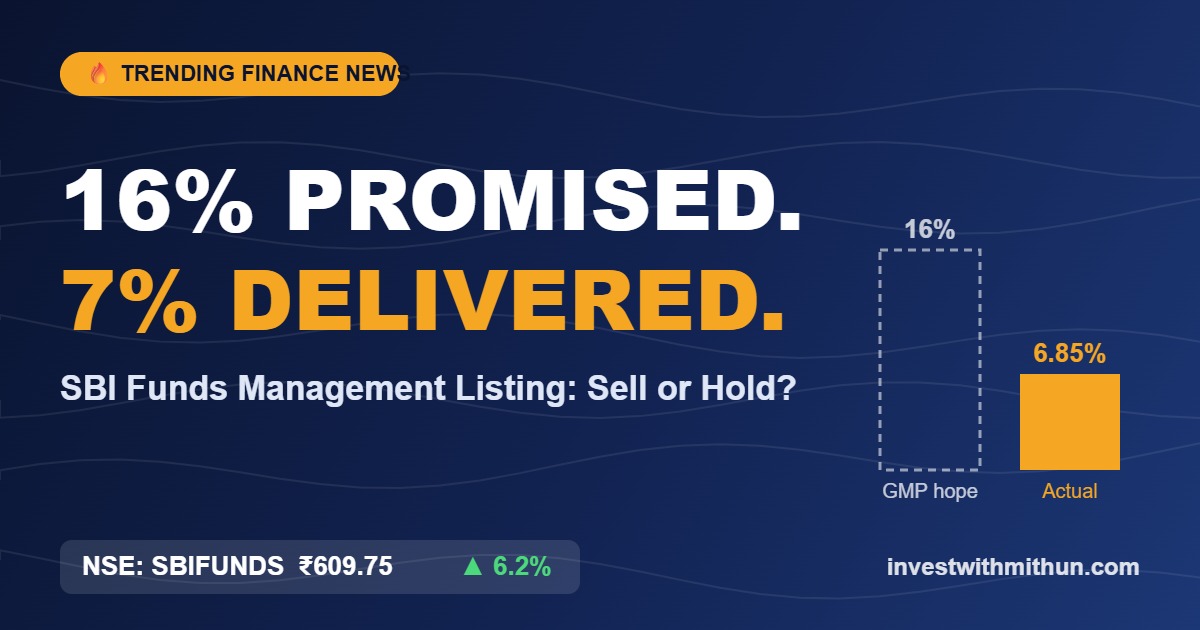
SBI Funds Management, the company that runs SBI Mutual Fund, listed on the NSE at ₹613.30 on Tuesday, July 21, 2026 — a premium of 6.85% over its issue price of ₹574. On the BSE, it opened at ₹610, up 6.27%. The grey market had been promising a listing pop of around 16%. Investors got less than half of that.
By the closing bell, the stock had cooled further to ₹609.75, about 6.2% above the issue price and slightly below its own listing price.
If you got an allotment and you’re wondering whether to book your profit or stay invested, this article breaks down exactly what happened today, why the listing was softer than expected, and what you can do next — in simple language. (If you missed it, read our pre-listing sell-or-hold playbook first.)
What Happened Today?
Here is the full listing-day scorecard:
| Detail | Number |
|---|---|
| Issue price | ₹574 per share |
| NSE listing price | ₹613.30 (+6.85%) |
| BSE listing price | ₹610.00 (+6.27%) |
| Intraday high (NSE) | ~₹624.90 |
| Closing price | ₹609.75 (+6.2% vs issue price) |
| Market cap at close | ~₹1.24 lakh crore |
| Gain per retail lot (26 shares) | ~₹930 at close |
The ₹9,813-crore IPO was entirely an offer for sale (OFS) — State Bank of India sold about 6.3% and its French partner Amundi sold about 3.7%. Not a single rupee of the IPO money goes into the company; it went to the two selling shareholders. After the listing, SBI still owns 55.46% and Amundi holds 32.56%, and SBI Chairman C.S. Setty said on listing day that the bank does not intend to dilute its stake any further.
The muted debut came on a weak market day. The Sensex fell for a second straight session, closing 238 points lower at 77,470, and the Nifty ended at 24,188. Brent crude hovered near $90 a barrel on continued US–Iran tension, HDFC Bank dropped another 2% after its margin disappointment, and FIIs were net sellers of ₹1,121 crore.
Why It Matters
This was not just another IPO. SBI Funds Management is India’s largest mutual fund house, managing roughly ₹12.5 lakh crore in mutual fund assets — about 15.3% of the entire industry. If you run a SIP in an SBI Bluechip, SBI Small Cap or SBI Contra fund, this is the company managing your money.
The subscription numbers were record-setting: the issue was subscribed about 41.7 times overall, with institutional investors (QIBs) bidding an extraordinary 140 times their quota. Retail investors subscribed a more modest ~3.6 times — and that gap between institutional excitement and retail caution turned out to be an early clue about the listing.
The listing also matters because it re-rates the whole AMC sector. HDFC AMC, Nippon Life AMC, UTI AMC, Aditya Birla Sun Life AMC and ICICI Prudential AMC now have a new, bigger benchmark to be compared against.
Why Was the Listing Weaker Than the GMP Promised?
The grey market premium (GMP) sat at ₹95–105 before listing, implying a 16–18% debut. The actual number was 6.85%. Four reasons explain the gap:
1. A nervous market. Listing day landed in the middle of a two-day market decline, with crude near $90 and a war still running in the Middle East. Listing gains almost always shrink when the broader market is red.
2. It was a 100% OFS. The company raised no fresh capital for growth. IPOs that are pure exits by existing shareholders often get a cooler reception.
3. The valuation was already “fair,” not cheap. At ₹574, the stock was priced at roughly 38 times FY26 earnings. After the 7% pop, it trades near 40–41x — almost exactly the sector average. HDFC AMC trades around 42x, ICICI Prudential AMC near 49x, Nippon around 51x, while UTI (32x) and ABSL AMC (34x) are cheaper. There was simply not much “listing gain” left on the table.
4. A lower-yield book. SBI Funds earns roughly 35 basis points on its assets, versus about 44 bps for HDFC AMC and 52 bps for ICICI Prudential AMC, because passive funds (index funds and ETFs, which charge tiny fees) make up about 32% of its mutual fund assets. Bigger AUM, but thinner fees per rupee managed.
Remember the GMP lesson: this is the second time in a week the grey market over-promised. GMP is an unofficial, unregulated signal — treat it as mood, not maths.
History Repeats: SBI Listings Are Usually Slow Starters
There’s a useful pattern here. SBI Life Insurance listed in October 2017 at a 5% premium and closed its first day just 1% above the issue price — a debut the media called disappointing. It went on to become a steady long-term compounder. SBI Cards listed in the COVID crash of March 2020 below its issue price. And LIC — the most hyped government-linked IPO ever — listed at a discount in May 2022.
Muted listing days and long-term performance are two very different things.
Impact on Sensex, Nifty and the AMC Sector
- SBI Funds Management enters the market as one of India’s 40–45 most valuable companies at ~₹1.24 lakh crore. Index inclusion (and the passive buying that follows) is a story for later quarters, not this week.
- For SBI shareholders, the bank has now monetised part of a crown-jewel subsidiary at a ~₹1.17–1.24 lakh crore valuation while keeping majority control.
- For listed AMC peers, a fairly-priced giant is now the sector’s reference point. Cheaper names like UTI AMC and ABSL AMC may face “why pay more?” questions; premium names must justify their higher fee yields.
- For the broader market, today’s real drag was not the IPO — it was oil near $90 (a pressure we unpacked in gold’s strange behaviour during this war), HDFC Bank’s margin worries and FII selling.
Expert Views
Brokerage Emkay Global initiated coverage on listing day itself with a Buy rating and a June 2027 target price of ₹750 — about 31% upside from the issue price — citing SBI’s brand, unmatched distribution reach and the under-penetration of mutual funds among SBI Bank’s own customer base. It values the stock at 39x FY28 earnings.
Analyst commentary broadly converged on one theme: the market is pricing SBI Funds as a high-quality, established business rather than a fast-growing story. Translation: expect earnings-led compounding, not multiple expansion.
(These are analyst opinions, not guarantees. Target prices routinely change.)
What Should Investors Do Now?
If you got allotment for listing gains: the trade underdelivered but still made money — roughly ₹930 per lot of 26 shares at the close. Short-term traders who exit now are booking a ~6% gain in a week. Nothing wrong with that.
If you can hold 3–5 years: the long-term case rests on India’s financialisation — SIP flows at record highs, mutual fund penetration still low by global standards, and the industry leader available at a sector-average multiple with a 43% return on net worth and 92% EBITDA margins. Emkay’s ₹750 target gives one roadmap.
If you didn’t get allotment: there is no urgency to chase. Two dates matter: August 16, 2026 (50% of the anchor lock-in opens) and October 15, 2026 (the rest opens). Lock-in expiries often create supply pressure and better entry points. Watching the stock through its first quarterly results as a listed company costs you nothing.
If you invest in SBI Mutual Fund schemes: nothing changes for you. Your SIPs, NAVs and expense ratios are governed by SEBI rules and are unaffected by where the AMC’s own share trades.
Key Risks to Watch
- Fee compression as passive investing grows (already 32% of its book)
- SEBI regulatory changes on total expense ratios (TERs)
- A prolonged equity market downturn shrinking AUM — and profits — automatically
- Lock-in expiry supply in August and October
- Scheme underperformance pushing investors to rivals
Frequently Asked Questions
1. What was the SBI Funds Management listing price?
₹613.30 on the NSE and ₹610 on the BSE, against an issue price of ₹574 — a premium of 6.85% and 6.27% respectively. The stock closed day one at ₹609.75.
2. Why did SBI Funds Management list below GMP expectations?
A weak market (Sensex down two days, crude near $90), a 100% offer-for-sale structure, a valuation already close to the sector average, and a lower fee yield than peers like HDFC AMC and ICICI Prudential AMC.
3. Should I sell SBI Funds Management shares or hold?
It depends on why you applied. Listing-gain applicants can book the ~6% profit. Long-term investors get the industry leader at roughly the sector-average P/E with best-in-class RoNW (~43%). Emkay Global has a Buy rating with a ₹750 target for June 2027. This is information, not personal investment advice — match the decision to your own goals.
4. Does the IPO affect my SBI Mutual Fund SIP?
No. Your mutual fund investments are held in schemes regulated by SEBI. The AMC’s share price has no impact on your NAV, SIP or expense ratio.
5. When do the lock-in periods expire?
Around August 16, 2026 for 50% of anchor shares and October 15, 2026 for the remainder. Both dates can bring extra selling supply.
6. Is SBI Funds Management expensive compared to HDFC AMC?
At ~40x earnings post-listing it is slightly cheaper than HDFC AMC (~42x) and well below ICICI Prudential AMC (~49x) and Nippon (~51x), but costlier than UTI AMC (~32x) and ABSL AMC (~34x).
Key Takeaways
- India’s largest AMC listed at a 6.85% premium — well below the ~16% the grey market implied — and closed at ₹609.75, up 6.2% on issue price.
- The soft debut says more about a nervous market (oil ~$90, FII selling, HDFC Bank drag) and full pricing than about the business, which earned ₹3,067 crore in FY26 at a 43% RoNW.
- GMP misled investors for the second time in a week. Treat it as sentiment, never as a promise.
- History rhymes: SBI Life also had a muted debut in 2017 and compounded steadily afterwards.
- Watch August 16 and October 15 lock-in expiries for potential better entry points.
Final Verdict
Today’s listing was a reality check, not a red flag. The market has priced SBI Funds Management as exactly what it is: a dominant, highly profitable, slow-and-steady market leader — not a lottery ticket. Traders got a modest win, long-term investors got a fair starting price, and everyone got a reminder that grey market premiums are gossip with a number attached.
For more stories like this, visit our Trending Finance News section.
This article is for educational purposes only and is not investment advice. Please consult a SEBI-registered investment adviser before making investment decisions. Market data as of the July 21, 2026 close; a few figures (such as intraday high) are from live exchange data and may be revised in the official end-of-day bhavcopy.
Try the tools every reader saves
Free. No signup. Built for Indian investors.